Despite producing nearly 15% of the UK’s spinouts, the Midlands has historically attracted only about 1% of UK venture capital investment in university spinouts.
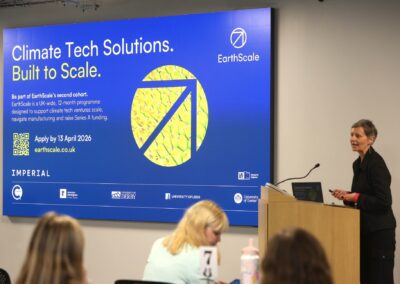
Our October 2026 event, hosted by the University of Nottingham, explored how universities, industry and civic partners can accelerate climate tech commercialisation across the Midlands, closing the gap between the region’s talent and the investment, manufacturing and policy support it needs to scale.
EarthScale is a collaborative network of university-led regional hubs building a connected, long-term ecosystem to scale the UK’s most promising climate tech ventures. The hubs are Imperial College London (lead), Cranfield University, the University of Derby, the University of Exeter, the University of Leeds and the University of Nottingham. Each hosts regional events showcasing local prototyping and manufacturing facilities and, crucially, strengthening links with investors, policymakers and climate-focused businesses, regionally and nationally.
The region has the tech, not the investment
In their first seven years, Midlands spinouts secure just 15p for every £1 raised by counterparts in the “Golden Triangle” of London, Oxford and Cambridge.
That funding gap was a common thread throughout the day. Joshua Hawkins of Midlands Innovation explained why: the region hasn’t had the infrastructure to capture and compound value locally. Midlands Innovation’s response is to build that missing layer, a fuller support system for spinouts, from new funds and science parks to talent programmes, to stop them and their value leaving the region.
Planning for a grid that doesn’t exist yet
Michael Gallagher of the East Midlands Combined County Authority (EMCCA) introduced the region’s new energy plans, the largest local area energy planning programme in England.
For the first time, the region has a single picture of where energy demand will grow and where the grid will come under strain. Without that visibility, the business case for siting energy-intensive climate tech manufacturing here has been harder to make than it should be. Michael tied the plan directly to the World Economic Forum’s Transitioning Industrial Clusters initiative, positioning the East Midlands as a test case for planning infrastructure around clusters of industries, not the other way around.
A former coal power station, repositioned for climate tech
Katie Greenhalgh, Head of Green Growth and Inclusion at East Midlands Freeport, set out how the former Ratcliffe-on-Soar power station, built for coal, is being repositioned with opportunities for climate tech companies looking to scale.
“The East Midlands has the talent and ideas to make a real impact in climate tech commercialisation. The opportunity now is to connect that innovation with the investment, manufacturing expertise and public-sector support businesses need to grow.
EarthScale has brought those conversations together to explore how we can help more climate-tech businesses scale here in the Midlands, creating skilled jobs and supporting a cleaner economy.
It was great to be able to share more about the opportunities presented by East Midlands Freeport to the next generation of innovative climate ventures at the EarthScale event and showcase the facilities we’ve supported at the Zero Carbon Innovation Centre.”
Inside the facilities: from propulsion testing to digital twins
The day closed with tours of two University of Nottingham Energy Institute facilities. Founders got a taste of what EarthScale makes available: a route to manufacturing and testing infrastructure that would otherwise take far longer, and far more capital, to access independently.
- Hybrid Propulsion Systems Building: high-power testing for propulsion systems used across transport industries, including cryogenic testing, altitude environmental chambers, and equipment for testing gaseous hydrogen, ammonia and other green fuels.
- Zero Carbon Innovation Centre (ZCIC): supports industry to develop, validate and test novel decarbonised products, with prototype manufacturing lines for scale-up and industrialisation. Its digital twinning lab enables model-based physics simulations, monitoring and prognostics for propulsion powertrains and power generation, linked to the megawatt-class physical testing at the nearby Power Electronics and Machines Centre (PEMC) and the Hybrid Propulsion Systems Building.
Facilities visit | Photography by Alex Wilkinson Media
Facilities visit | Photography by Alex Wilkinson Media
What’s next
EarthScale is a 12-month programme connecting founders to a UK-wide network of university hubs, so teams can stay rooted in their own region while gaining access to manufacturing facilities, investors and specialist advice.
Ben Mumby-Croft of Imperial College London opened the day by setting out how university ecosystems like EarthScale’s are designed to catalyse this kind of commercialisation. Ben Sumner of the University of Nottingham closed it locally, describing how the University is working with industry to deliver the next generation of net zero technologies.
Applications for EarthScale Cohort 3 are now open, with a deadline of 20 November 2026.
Missed this event?